
A closer look at JPool, our liquid staking partner on Solana
What JPool is and how it works: JSOL liquid staking, direct staking to your chosen validator, stake matching, and the Community Good program that backs Solana builders.
JPool has been part of my validator story for a while: my liquid staking partner since autumn 2025, one of the first teams to back my projects through the Community Good program, and a pool I watch closely in my own staking data. This article is a walk through what JPool actually is and why it is worth knowing for anyone who stakes SOL, runs a validator, or simply cares about how stake moves on Solana.
What is JPool
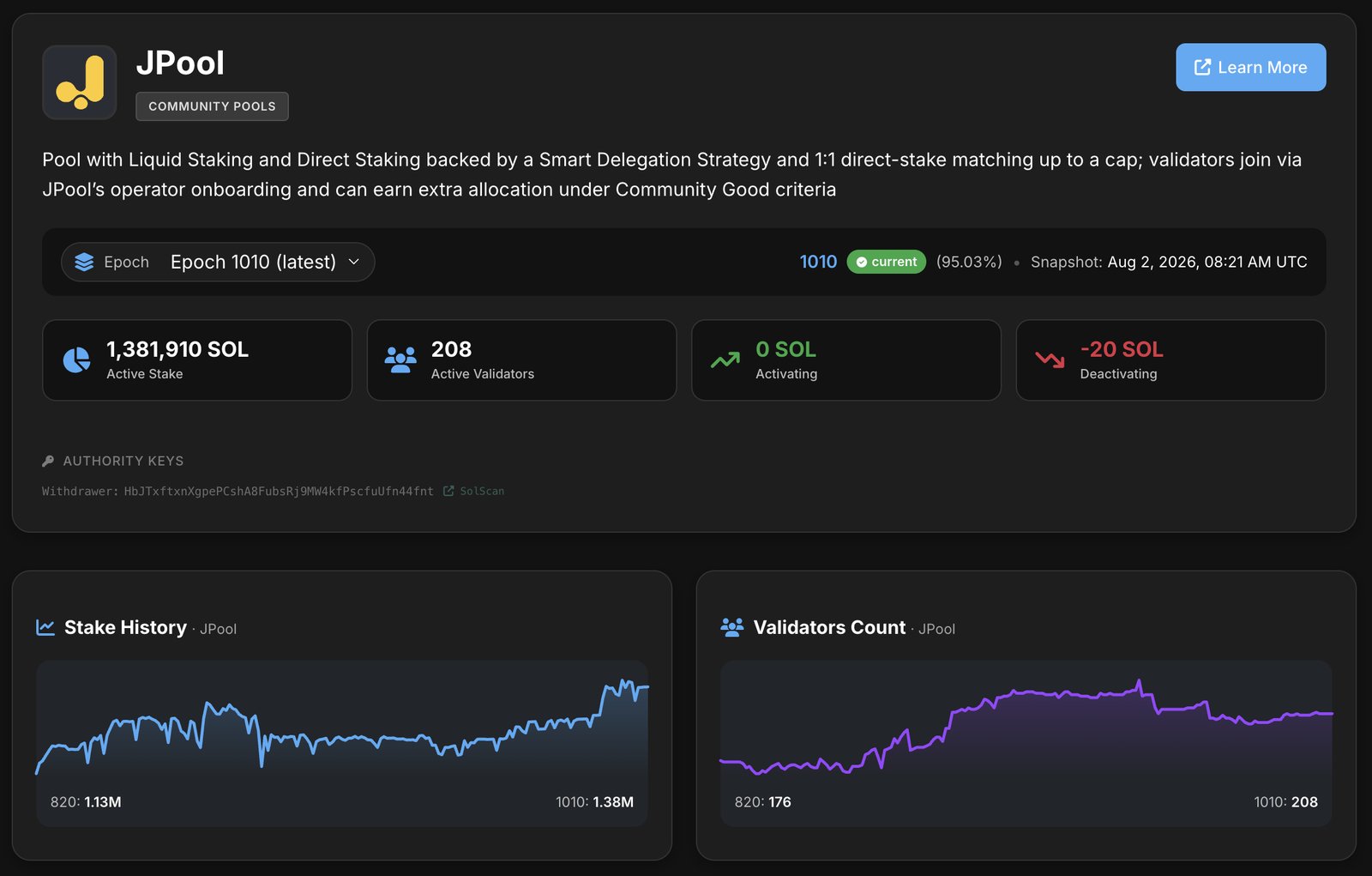
JPool has been running on Solana mainnet since 2021, and today it is one of the largest community-driven stake pools in the ecosystem: over a million SOL delegated across more than two hundred validators. Like every stake pool, it is built around a liquid staking token - JSOL. You stake SOL, you receive JSOL, and your position keeps earning while staying liquid: no lock-ups, and the token can work for you across Solana DeFi while the stake works for the network.
Direct staking: choose your validator, stay liquid
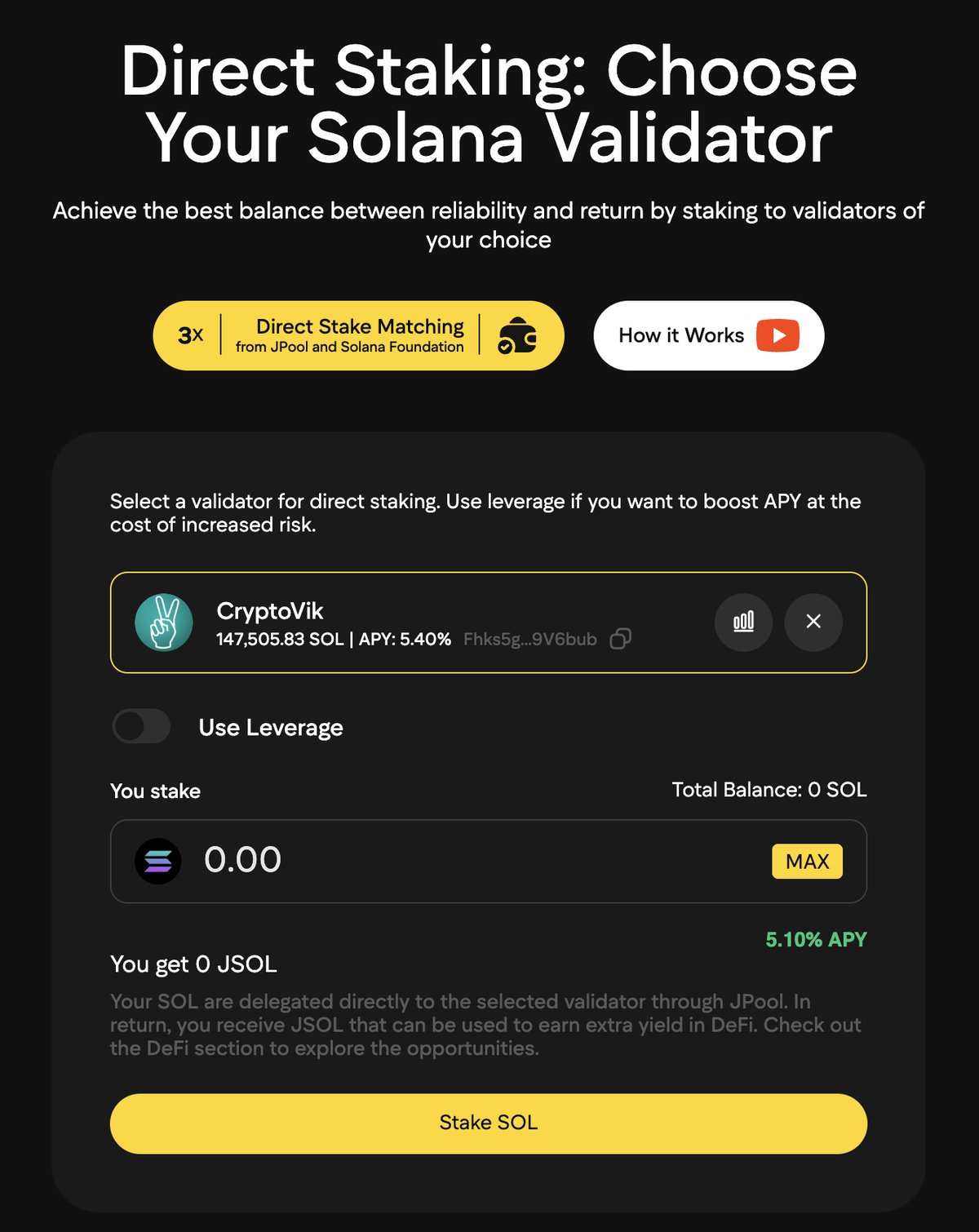
Liquid staking itself is table stakes now - every pool is built on an LST, and many validators issue their own. What makes JPool stand out is choice. You can hand the decision to the pool’s delegation strategy, the classic way, and let it spread your SOL across its cohorts. Or you can pick the exact validator you want to support - that is direct staking. You keep self-custody, you still receive JSOL, and backing a specific operator no longer costs you flexibility. Only a handful of pools on Solana offer this mode.
For validators the deal is just as interesting. JPool matches direct delegations with additional stake of its own on top, up to a cap, and validators in the Solana Foundation’s delegation program get further matching from that side too, so every SOL delegated directly carries extra weight for the operator you chose.
How JPool distributes stake
Under the hood, JPool’s delegation program splits stake across three buckets. Direct stake matching amplifies the delegations users make to specific validators. The performance bucket is a yield competition: validators that pass the pool’s baseline checks are ranked by APY and compete for delegation slots. And Community Good, a third of the pool’s stake, goes to validators whose teams demonstrably build for the Solana ecosystem.
JPool has also shipped a public delegation dashboard - a heatmap that shows which validator sits in which bucket and how much stake each slot carries. Transparency of this kind is still rare among pools, and it is exactly the kind of data I like to see in the open.
Community Good: stake for builders
Community Good is the part of JPool I value most, because it points stake at people who build. The program reserves 30% of the pool’s stake for validators with verified ecosystem impact: public tools, education, infrastructure, research. Applications are scored against published criteria, and the delegation is distributed in proportion to those scores - the more a team contributes, the more stake the algorithm routes its way.
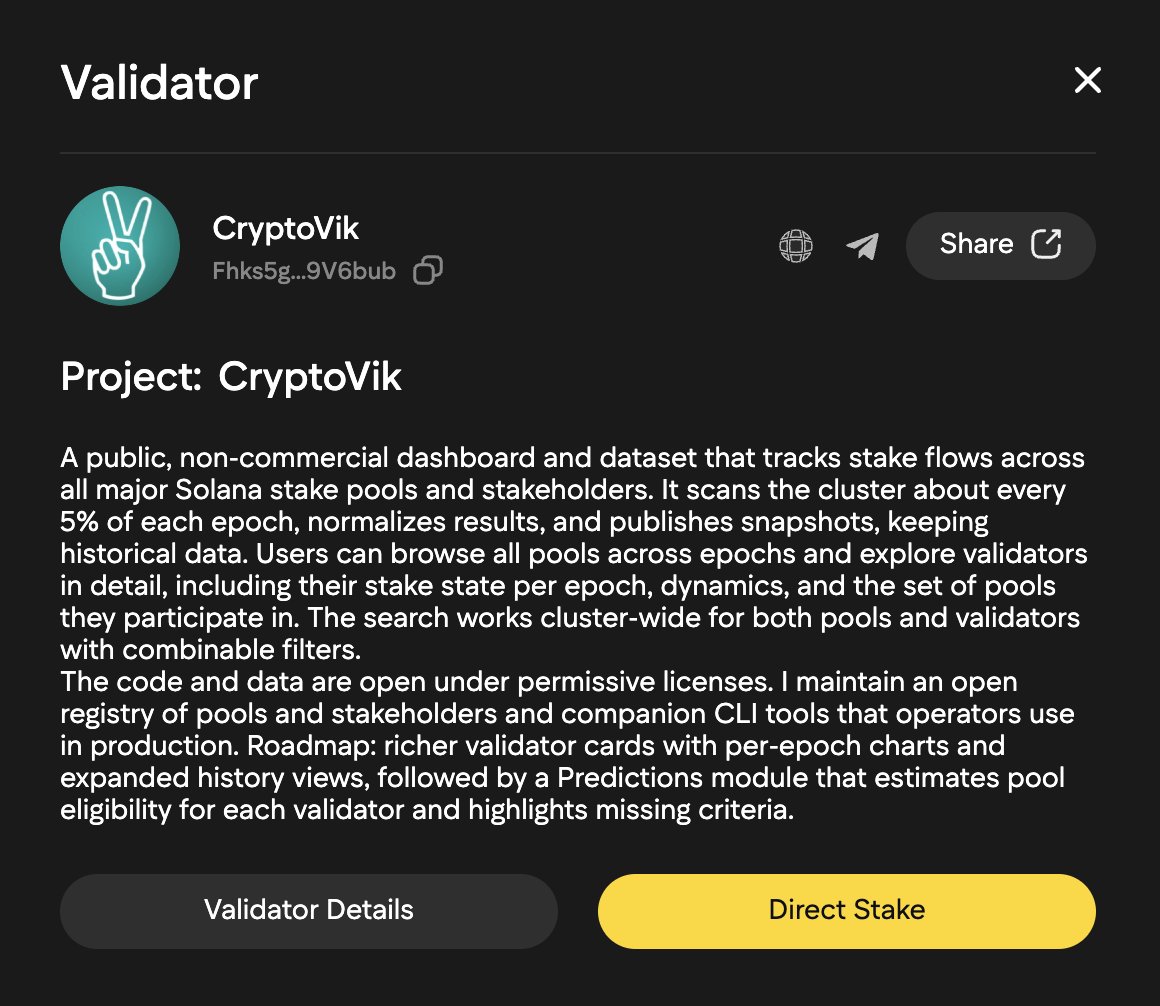
CryptoVik has been in the program since 2025 with the StakePools Dashboard and the open validator tools around it. JPool was one of the first teams in the ecosystem to back the dashboard with actual stake, and for a non-commercial project that support is a real reason to keep building. Who is in the program today is visible on that same public dashboard.
I follow the program well beyond my own slot in it. I keep an eye on how the rules evolve and on what the teams on that list are building, partly with future updates to my own dashboard in mind, and I watch how JPool’s stake actually moves across validators epoch by epoch. So the next step feels significant to me: in July 2026 JPool announced a Validator Council - five community members, validator operators, developers, and community representatives, who will score Community Good applications instead of a small internal team, with independent written evaluations and published final scores. For a program that hands out a third of a major pool’s stake, moving the judgment into the community’s hands is, in my view, the right direction.
A team that keeps shipping
What I like most about JPool is the pace. This is a team that keeps building things validators and stakers actually use: a mobile validator dashboard app, a validator profit calculator, the Smart Validator Toolkit for node monitoring, and one of the fullest validator profitability histories on Solana - I use it myself in side projects. There is even Campus, their education hub - with a Ukrainian version among its four languages, by the way. The newest one is Chainbook, a bookkeeping tool that turns raw Solana transaction history into something human-readable: addresses resolve into names, SOL and wSOL are treated as one asset, and the usual explorer noise becomes a ledger you can actually read and even hand to your accountant. And their feed regularly features other builders’ work, not just their own.
CryptoVik and JPool
JPool has been my liquid staking partner since autumn 2025. In practice it is a simple habit: when someone wants to stake to my validator and stay liquid, I point them to JPool, and their direct staking lives on my stake page. When one of us ships something worth showing, the other shares it. I like this kind of cooperation - unhurried and built on respect for each other’s work.
My dashboard tracks JPool alongside every other pool - here is its live page, with stake history and validator counts epoch by epoch.
If you hold SOL and want it to back a specific independent validator without giving up liquidity, direct staking through JPool is the cleanest way I know. If you run a validator and build something useful for the ecosystem, Community Good is worth applying to. And if you want to see where stake actually flows - my dashboard is at your service, and I keep building.
Read more
 Alpenglow explained: Solana's new consensus, tested from the inside What Alpenglow changes on Solana: finality in 150 milliseconds instead of 12.8 seconds, cheaper validator voting, and life inside the community test cluster.
  Joining Superteam Ukraine: from Kumeka Team to a global Solana network CryptoVik is now a Superteam Ukraine member. The story of a community that grew from Kumeka Team into the Ukrainian hub of a global Solana network, told from a validator seat.